
Talking Story with Steve Cheney, Part 3
November 10, 2026 • Geronimo "Geri" Valdriz • Steel Guitar History
PART THREE
GV: What is your go-to steel guitar today?
SC: I'm a wood worker so I built my own custom steel guitar. I used to make very fine furniture, mostly with koa wood. So, it was no problem for me to make my own instrument.
I had my double neck Fender, then I moved on to an Excel Jerry Byrd Model. I didn't like the quality of the Excel, it was alright but not of high quality. I also played my grandfather's pedal steel guitar when I first started at the Polynesian Cultural Center but took off the pedals and made it a non-pedal Hawaiian style. Then I bought a Console made by steel guitarist Herb Remington.
I didn't like the quality of any of the steel guitars given to me or that I purchased, so I thought that I should make my own high-quality instrument. I made a double neck 8 string console, using Honduras Mahogany. I made all of the aluminum parts such as the bridge, the tuning mounts and the nut. I designed the fingerboard and had it fabricated at the BYUH signage shop.
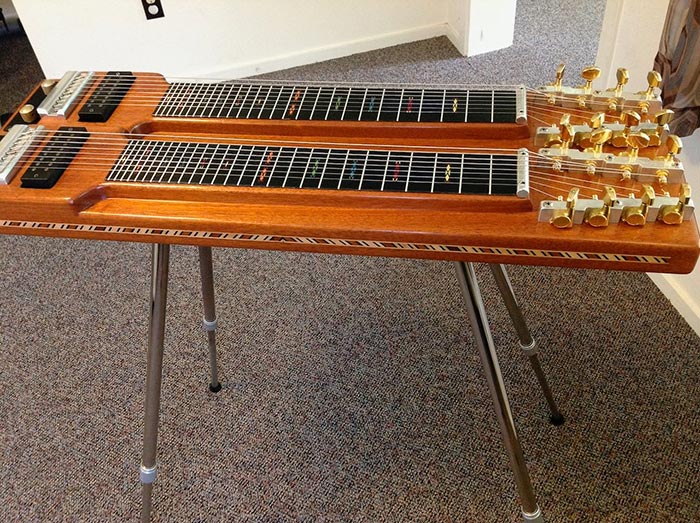
Steel Guitar built by Steve Cheney
I used the 22.5" scale and purchased the tuners and the telescopic legs. I put in Bill Lawrence Pickups, they make real good humbucking magnetic pickups for the steel guitar. I also wired the pickup together, connecting the volume and tone control pots and made sure that it is grounded.
I also made an identical single neck 8 string steel guitar that my son Ben uses. I still have the Excel, but it stays at home for practice.
GV: I notice that the steel guitars you mentioned are console, stand up style steel guitars. Do you play lap steel guitars?
SC: I do have an old 8 string Fender lap steel given to me, put away and not used.
Throughout my life I've always stood up and played on a console steel guitar.
GV: I assume that you favor eight string over six string?
SC: I haven't played a six string since my first lessons back in Utah!
GV: What is your tuning on your steel guitar?
SC: In the late-1980s I changed my tuning from E7th to E13th. I don't remember how I learned this tuning. I either figured it out myself or got the tuning information from where I don't remember. I know that it took me some time to change and become proficient in the E13th tuning.
Basically, I added a C# to my E7th tuning. I realized that by adding the C# I was getting closer to Benny Rogers' tuning, and that really made a difference. My current E13th tuning, high to low is (G# / E / C# / B / G# / E / D / E). I've been playing this tuning for a while now and I know it like the back of my hand!
My inside neck tuning is E13th and my outside neck tuning is B11th. I use the B11th to play "Sand," "How D'ya Do," and that kind of stuff. I found this tuning listed in the Lorene Ruymer book about Hawaiian Steel Guitar. I chose it because its top three strings are the same as my "A" tuning. My B11th tuning high to low is (E / C# / A / F# / Eb / B / F# / B).
GV: What kind of strings do you use?
SC: I buy my strings in bulk from Breezy Ridge Instruments, home of John Pearse Strings in Pennsylvania. They come 10 strings per set for plain and 5 strings per set in the wound.
I keep my strings in a Cabinet that I made. It has a "Golden Rod" heating bar to keep the moisture out of the cabinet. The strings do not go bad because the heating bar in the cabinet keeps the moisture out.
GV: What gauges of strings do you use for your tuning?
SC: For the E13th tuning it is high to low (G# .011p / E .015p / C# .018p / B .020p / G# .024w / E .030w / D .032w / E .052w)
For the B11 tuning it is high to low (E .015p / C# .018p / A .022p / F# .024w / Eb .032w / B .038w/ F# .052w/ B .064w)
GV: What kind of bar do you use?
SC: I also buy my bars from John Pearse and the company makes a stainless steel bar 3/4" in diameter by 2 7/8" long. It's called the "Hawaiian Steel Bar" and the size is perfect for 8-string steel guitar. I haven't used any other type of bar because the John Pearse bars are really good and there is no need to change.
GV: What kind of a thumb pick do you use?
SC: I use "Golden Gate" thumb picks (bought through Amazon). They are actually thicker and sturdier and I like that. They are advertised for banjo players but I like the feel of them. I don't like my thumb pick too loose or too flexible. I like them to stay in their shape.
GV: What kind of fingerpicks do you use?
SC: I use Dunlop fingerpicks. I use the thicker .025 gauge fingerpicks.
GV: What kind of amplifier do you use?
SC: At the Polynesian Cultural Center all the instruments are plugged into a direct box (DI), so there is no need for an amplifier. If I do need an amplifier I use a Bose amp that is made for use as a speaker on a PA mixer, or a musical instrument. It is the S1 Pro Portable speaker. It also has a battery in it that lasts for 4 hours. It sounds just fine to me.
GV: What kind of guitar cable do you use? Any particular brand or type?
SC: I don't know the brand that I use, but I always try to get the absolute best cable that I can afford. I usually buy from Stew Mac or Musician's Friend online. I also use a product called a "Deoxit" contact cleaner from Amazon (small bottle that looks like red fingernail polish with brush) to maintain my cable, equipment, and control pots. The pots give me years of no problem thanks to Deoxit.
GV: Do you still practice on your steel guitar?
SG: I hardly practice because I play almost every night. If I have to go over something new then I make time to practice. Otherwise, I am busy during the day and then I head to the lū‘au to play in the early evenings.
GV: Do you get nervous when you are on stage playing?
SC: I am very comfortable playing at the Polynesian Cultural Center lū‘au because it's a job that I play at night after night with the same musicians. I don't get nervous when I play.
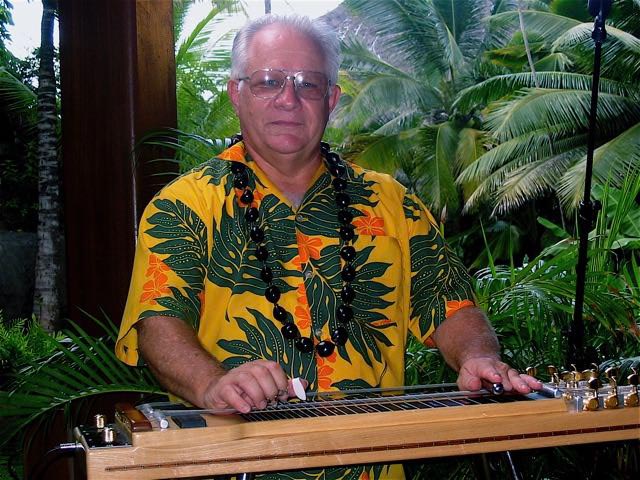
Steve Cheney at the PCC
When I started playing outside of the lū‘au for concerts and steel guitar festivals I was nervous at first, but now I feel comfortable. The steel guitar festival is good for me because I play with other musicians and I can play songs that I don't normally play at the lū‘au. You need to break the mold sometimes and the festivals allow me to do that.
GV: What do you like to do when you are not playing the steel guitar (hobbies or other instruments)?
SC: I am a builder, and during the day I work on renovating or repairing projects at my home in Hau‘ula or my wife's home in Punalu‘u. I am busy all the time because I don't rush things, I take my time, and I always do a good job. People are always calling me for advice or help on a repair or maintenance.
In January 2022, I re-married to Ailene Mililani Hung Quan Sproat, a widow from Punalu‘u. My family knew her family for decades. I spend most of my time between her home in Punalu‘u and my home at Hau‘ula!
GV: Do you listen to music other than Hawaiian music?
SC: No, when I am driving my car I don't like to be distracted so I don't listen to any music on the radio. And when I get home I don't listen to the radio or play CDs or hear any type of music. The only time I hear any kind of music is when I get to the lū‘au and play. And that's Hawaiian music!
GV: So what is your current playing schedule at the Polynesian Cultural Center L?`au?
SC: Well it takes about 15 minutes to drive from my home to work. I tune and set up my steel, then we begin playing dinner music at 4:45pm. It's like a pre-show while the guests are arriving. The dinner music lasts until 5:25 pm, we take a break, then start the Polynesian show at 5:40pm until 6:15pm I do this six-nights a week during the Summer months.
GV: Looking back now, who do you consider to be your favorite steel guitarist?
SC: My favorite steel guitarists continue to be Benny Rogers and his nephew Feet Rogers.
GV: Do you teach steel guitar?
SC: I had several people approach me in the past to teach them to play the steel guitar, but they all quit! I wasn't even charging them, all manuahi just to help them out. And it was waste time for both of us. They didn't follow up, practice, or whatever!
I did pass on the steel guitar to my four sons. My son Benjamin currently plays at the Hale ‘Ohana, the second lū‘au at the Polynesian Cultural Center. My other sons have moved to the mainland and they each can play the steel guitar.
GV: What is the future of Hawaiian steel guitar in Hawaiian music?
SC: Hawaiian steel guitar is progressing in the right direction especially because of what Alan Akaka is doing by teaching and promoting the Hawaiian steel guitar festivals. It's a good thing, especially bringing in younger players…
We ended our long telephone interview, said our alohas and made plans to meet up at the next Steel Guitar Festival. All pau!
FeatureArchives
November, 2026
October, 2026
September, 2026
August, 2026
July, 2026
June, 2026
Complete Issue Archive
Complete Series Archive
Categories
Education and TrainingEntertainment
Equipment
Festivals and Conventions
Instruments and Luthiers
News
Steel Guitar History
Authors
Author IndexHIMELE Events
2026 Festivals and Workshops
Hawai‘i Island Steel Guitar Experience at Mauna LaniNovember 19-22, 2026 – Mauna Lani, Auberge Collection, Waimea, Hawai‘i Island
2027 Festivals and Workshops
Hawaiian Steel Guitar Festival at Ka Makana Ali‘iJanuary 30, 2027 – 11:00 AM - 3:00 PM HST
Ka Makana Ali‘i Shopping Center, Kapolei
Hilo Steel Guitar Festival
March 13, 2027 – 11:00 AM - 3:15 PM HST
Prince Kuhio Plaza, Hilo, Hawai‘i
NextGEN Hawaiian Steel Guitar Festival
April 3, 2027 – 11:00 AM - 1:00 PM HST
Ka Makana Ali‘i Shopping Center, Kapolei
Kaua‘i Steel Guitar Festival
May 2, 2027 - 10:30 AM - 2:45 PM HST
Kukui Grove Center, Lihue, Hawai‘i
Hawaiian Steel Guitar Festival at Windward Mall
June 12, 2027 – 11:00 AM - 3:00 PM HST
Windward Mall, Kane‘ohe
Royal Hawaiian Center Presents Waikīkī Steel Guitar Week - July 4-10, 2027
July 5, 6, 8, 2027 – 5:30 PM - 6:30 PM HST (Nightly Concerts)
Royal Grove Stage, Royal Hawaiian Center, Waikīkī
2nd Annual Ho‘okūkū Kīkā Kila - Hawaiian Steel Guitar Contest
July 7, 2027 – 4:30 PM - 7:30 PM
Royal Grove Stage, Royal Hawaiian Center, Waikīkī
Royal Hawaiian Center Presents J-FESTA 2027 - Japan-Hawaiian Steel Guitar Festival
July 9, 2027 – 3:00 PM - 6:30 PM HST
Royal Grove Stage, Royal Hawaiian Center, Waikīkī
Royal Hawaiian Center Presents Waikīkī Steel Guitar Festival
July 10, 2027 – 11:00 AM - 1:50 PM and 4:00 PM - 6:30 PM HST
Royal Grove Stage, Royal Hawaiian Center, Waikīkī
NextGEN Hawaiian Steel Guitar Festival at Windward Mall
August 14, 2027 – 11:00 AM - 1:00 PM HST
Windward Mall, Kane‘ohe
Maui Steel Guitar Festival
October 16, 2027 - 3:00 PM - 6:30 PM HST
The Shops At Wailea, Wailea, Hawai‘i
Hawai‘i Island Steel Guitar Experience at Mauna Lani
November 11-14, 2027 – Mauna Lani, Auberge Collection, Waimea, Hawai‘i Island (tentative)
Other Events
2026 Events
Steel Guitar FridaysEvery Friday – 5:30 PM - 6:30 PM
Royal Grove Stage, Royal Hawaiian Center, Waikīkī
2027 Events
AISGC Hawaiian Steel Guitar Festival #July 22-24, 2027
Winchester Towne Square Community Centre, Winchester, Indiana
Austin Steeel Guitar Fest #
September 30-October 2, 2027
Austin Marriott South, Austin, Texas
* Tentative
# Registration Fee Required
Copyright ©2026 by Hawaii Institute for Music Enrichment and Learning Experiences, Inc., and Cyberventures Unlimited.Terms of Use
About HIMELE
HIMELE is a Hawai‘i 501(c)(3) non-profit corporation that supports music enrichment and education for people of all ages. Our purpose is to educate, promote, and perpetuate Hawaiian music, Hawaiian culture and Hawaiian musical instruments.
Visit HIMELE
Board of Directors
Mission Statement
Support Us
Learning Resources
Ke Kula Mele Hawai‘i
Hawaiian Steel Guitar Symposium
Statewide Festivals
Kaua‘i Steel Guitar Festival
Maui Steel Guitar Festival
Hawai‘i Island Steel Guitar Festival
Kona Steel Guitar Festival
Hilo Steel Guitar Festival
J-FESTA | Japan-Hawaiian Steel Guitar Festival
Waikīkī Steel Guitar Week
Community Festivals
Ka Makana Ali‘i – Kapolei
Windward Mall – Kāne‘ohe
NextGEN Hawaiian Steel Guitar Festivals
Livestream Hawaiian Steel Guitar Showcase