
Talking Story with Steve Cheney, Part 1
September 17, 2026 • Geronimo "Geri" Valdriz • Steel Guitar History
PART ONE
Steve Cheney is a master Hawaiian steel guitar player who has spent a lifetime performing in hula shows, lū‘aus, major hotels, military clubs, and concert stages throughout Hawai‘i. He is a multi-talented musician who plays the jazz trombone, electric bass, tuba, and conga drums. Beyond traditional Hawaiian music, his expertise covers Jazz, Contemporary, and Dixieland/Ragtime.
Steve is also a master craftsman and accomplished woodworker. He designed and built several of his own custom steel guitars used for performing. He spent 32 years at the Brigham Young University-Hawaii, and retired supervising the architectural department.
As a steel guitarist Steve had to overcome adversity after an injury to his left hand. In 1972, an industrial accident claimed the tip of Steve's ring finger, half of the middle finger and the outside joint of the index finger was shortened and fused. Because the left hand controls the bar, he spent an entire year relearning how to hold and slant the steel bar to play again.
I first saw Steve Cheney in the book "The Golden Years of Hawaiian Entertainment" by Tony Todaro, published in 1971. He was featured as a young, contemporary Hawaiian steel guitarist. Through the years I heard his name mentioned as the steel guitarist at the Paradise Cove Lū‘au at West O`ahu, and later at the Polynesian Cultural Center Hale Aloha Ali‘i Lū‘au at Lā‘ie.
I finally met Steve in 2023 after I retired and got actively involved with the Hawaiian Steel guitar festivals. We see each other yearly as performing artists at the Waikīkī Steel Guitar Ho‘olaule‘a. I know him as a humble, thoughtful, sweet and genuine person. I made arrangements with Steve to have a "talk story" about his life as a steel guitarist. We followed that up with a telephone interview on July 21, 2026. I was at home in Waiehu, Maui and Steve was at his home in Hau‘ula, O‘ahu.
GV: To give our readers a taste of who you are, I'm going to start off by asking you about some of your likes or dislikes.
SC: Okay!
Spam and eggs or Loco Moco? They're both good, but Loco Moco.
Mango or Lychee? Mango.
Sunday M?noa or Hui Ohana? Hui Ohana, I know them.
Plumeria lei or Kukui Nut lei? Kukui nut lei!
Mauka or Makai? Makai, I like the ocean, that's where I head.
GV: Where do you live now and where are you originally from?
SC: I presently live at Hau‘ula, O‘ahu. I've been here since 1971. I was born in 1948 at Salt Lake City, Utah. I attended Elementary school in Salt Lake City, and Intermediate School at Centerville, Utah. In 1964 my family moved to Kailua, O‘ahu. I graduated from Kailua High School in 1966 and later attended Church College of Hawaii (now Bringham Young University Hawai‘i ("BYUH").
GV: What got you into playing Hawaiian music? How did it all start for you?
SC: My family was very musical and my parents loved Hawaiian music. My father (Garth Cheney) tuned pianos for a living and my mother (Irene Cheney) was a professional synchronized swimmer. She was among the top six in the nation!
My parents were also performing musicians. They taught the children music at home, and paid for private music lessons. My mother played the piano and she gave me piano lessons at home, when I was 5 or 6, but I wasn't ready for it and soon gave up.
At age 12 I began taking private lessons on the baritone horn from Cleon and Glenn Dalby. At the same time I learned to play the electric bass guitar from my father.
At age 13 I took steel guitar lessons from James Mulligan (a Cherokee Indian) in Ogden, Utah. His steel guitar playing was right out of the 1930's and he taught me to play the E7th tuning.
At the same time I began playing bass and sousaphone with the "The Islanders". This was our family group consisting of my grandfather (Max Christensen) on pedal steel and plectrum banjo (Eddie Peabody style); my father on rhythm guitar and tenor banjo; and my mother on the vibraphone and ragtime piano. We played Hawaiian, Contemporary, Dixieland and Ragtime music. Watching my grandfather play the steel guitar was helpful to my own steel guitar lessons.
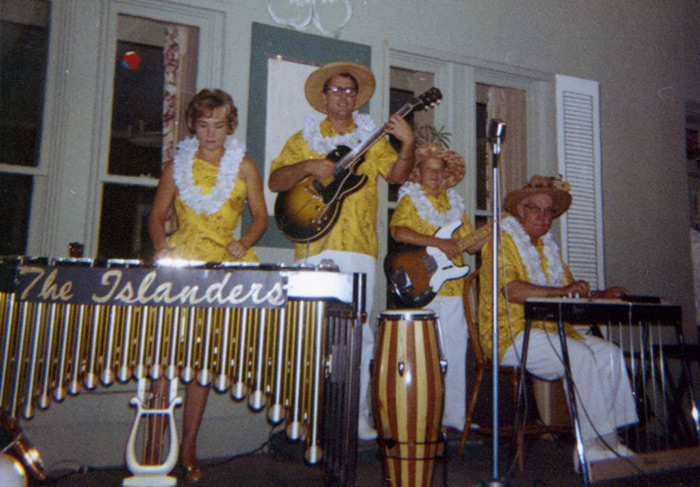
The Islanders at The Homestead - 1962
Each summer The Islanders played at a place called "The Homestead" up in the mountains at Midway, Utah. On the weekends we performed throughout the Salt Lake City area from 1961 to 1963.
During this period I took private Conga Drum lessons from Stan Evans for nine months. I also took bass guitar lessons from Ralph Pena, bassist for George Shearing. This was not a private lesson, it was taught to a class at the University of Utah.
In 1963 my grandfather left the group and we renamed the band "The Cheney Family". My sister Debbie and my younger brother Boyd joined the group. She played ukulele and he played the bass. I switched to the steel guitar.
In 1964 the Cheney Family moved to Hawai‘i. My parents really loved Hawaiian music and they wanted to be closer to its source. We were a family band and we played Hawaiian music – so to learn it better we came here to Hawai‘i. We were tutored in Hawaiian music, and language by Alice Namakelua.
We lived at Kailua, O‘ahu and began to settle in to the island life. In time our family began performing at the major hotels in Waikīkī, at military clubs, and at the Outrigger Canoe Club (for two years). We played at church functions, private parties and other venues. We were very busy, playing six nights a week!
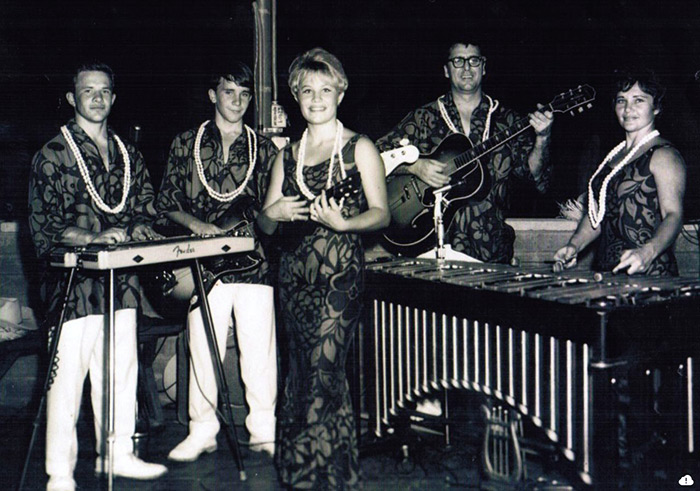
Cheney Family, February, 1968 at Johnston Island
In 1968 "The Cheney Family" LP recording was released. It consisted of old time Hawaiian songs such as "Pua Ahihi", "Kalamaula", "Adios Ke Aloha", "Hoe Hoe Na Wa‘a" and others. I helped to produce the album and I played Hawaiian steel guitar instrumentals such as "Maui Chimes - Hilo March" and "Kohala March - Honolulu March"!
In 1969 my parents divorced, and the Cheney Family group disbanded.
GV: After graduating from Kailua High School in 1966, you attended Church College of Hawaii (Brigham Young University-Hawaii). What were you studying?
SC: I went to the Church College of Hawaii to study building technology. I was a woodworker and I liked to build koa furniture and repair, renovate, and construct homes. I had received a student music scholarship and I played electric bass and trombone in jazz bands.
In 1971 I got married and my wife (Belinda) and I moved to Hau‘ula. I attended college until early 1973 because I was starting a family, had lost some fingers and had limited employment opportunities because of the healing process from the lost fingers. I finally returned to classes at BYUH and graduated in 1990 with a degree in Building Technology. I build homes, I design them.
In 1974 I was hired by the Polynesian Cultural Center (PCC). I was a finish carpenter and then asked to be an electrician. I also was a cabinet and furniture maker.
In 1979 I was hired by Bringham Young University as a finish carpenter for ten years. In 1989 I moved to the Architect planning office at BYUH and retired in 2012 as the supervisor.
FeatureArchives
October, 2026
September, 2026
August, 2026
July, 2026
June, 2026
May, 2026
Complete Issue Archive
Complete Series Archive
Categories
Education and TrainingEntertainment
Equipment
Festivals and Conventions
Instruments and Luthiers
News
Steel Guitar History
Authors
Author IndexHIMELE Events
2026 Festivals and Workshops
Maui Steel Guitar FestivalOctober 17, 2026 - 3:00 PM - 6:30 PM HST
The Shops At Wailea, Wailea, Hawai‘i
Hawai‘i Island Steel Guitar Experience at Mauna Lani
November 19-22, 2026 – Mauna Lani, Auberge Resorts Collection, Waimea, Hawai‘i Island
Other Events
2026 Events
Steel Guitar FridaysEvery Friday – 5:30 PM - 6:30 PM
Royal Grove Stage, Royal Hawaiian Center, Waikīkī
2026 HSGA Festival #
October 22-25, 2026.
Hotel Paradox, Santa Cruz, California
* Tentative
# Registration Fee Required
Copyright ©2026 by Hawaii Institute for Music Enrichment and Learning Experiences, Inc., and Cyberventures Unlimited.Terms of Use
About HIMELE
HIMELE is a Hawai‘i 501(c)(3) non-profit corporation that supports music enrichment and education for people of all ages. Our purpose is to educate, promote, and perpetuate Hawaiian music, Hawaiian culture and Hawaiian musical instruments.
Visit HIMELE
Board of Directors
Mission Statement
Support Us
Learning Resources
Ke Kula Mele Hawai‘i
Hawaiian Steel Guitar Symposium
Statewide Festivals
Kaua‘i Steel Guitar Festival
Maui Steel Guitar Festival
Hawai‘i Island Steel Guitar Festival
Kona Steel Guitar Festival
Hilo Steel Guitar Festival
J-FESTA | Japan-Hawaiian Steel Guitar Festival
Waikīkī Steel Guitar Week
Community Festivals
Ka Makana Ali‘i – Kapolei
Windward Mall – Kāne‘ohe
NextGEN Hawaiian Steel Guitar Festivals
Livestream Hawaiian Steel Guitar Showcase