
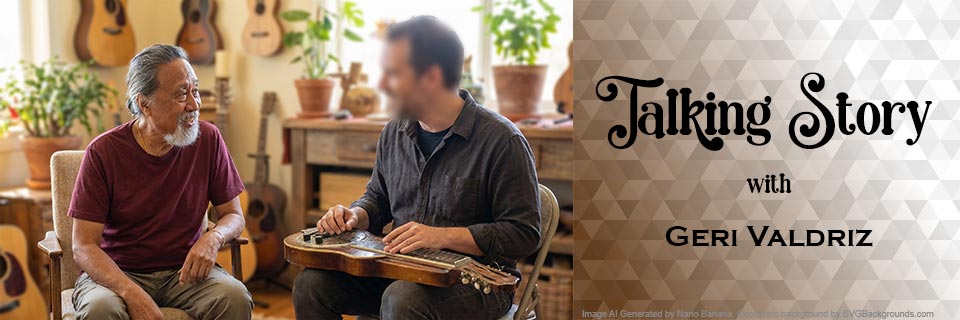
Talking Story with Dwight Tokumoto, Part 2
July 10, 2026 • Geronimo "Geri" Valdriz • Steel Guitar History
PART TWO
GV: What got you into playing Hawaiian steel guitar in the first place? How did it all start for you?
DT: When I joined the Navy, I brought my classical guitar with me and played it in my spare time. In the last year that I was in the service I learned to play Chet Atkins style guitar from my night shift supervisor who I worked with. He was from West Virginia. He held a flat pick, his hand muffled the bass strings and he played the melody of the song with his fingers, all at once! That blew my mind. It took me two weeks to learn the basics of that fingerpicking style. I bought Chet Atkins records and practiced endlessly to copy the sound I was hearing.
A few months later I see the same guy but this time he is playing a pedal steel guitar. I thought it was a broken machine or something! I told him that the Hawaiians play in the same style and he said "that's right!" When I heard that music, I got chills and I said "I know that sound." I remember it growing up.
GV: Tell me about your first lap steel guitar.
DT: When I heard my Navy friend play the pedal steel I went to a pawn shop in San Diego and I bought an old wooden 6 string electric steel guitar made by Dobro. It had the old-style screw-on input jack, and the bar and the picks also came in the case. I tuned it to a slack key open G tuning, although I really didn't know what I was doing. I didn't have a tuner so I tuned it by ear.
As time went on, I taught myself how to play the lap steel. I didn't take lessons from anyone, but I picked up things here and there. There were no books when I first started, and no teachers. I didn't know that Jerry Byrd was giving lessons, I never heard about him until later on.
I learned slowly from listening to records by Genoa Keawe with Benny Rogers on the steel, and the Hawai‘i Calls radio show with Barney Isaacs and Jules Ah See. I also knew a little about music theory so I understood things like tunings, intervals, and harmony. I just had to capture that Hawaiian "feel" in my playing. An old man once told me to learn as much songs as I can. Learn the melody and learn the chords.
I tried various tunings such as A, E7, B11, C#m9, but I settled on the C6 tuning used by David Keli‘i. It is tuned from high to low E / C / A / G / E / C. Sometimes I retune for playing certain songs. If I play "Sand," I tune my steel to B11.
GV: You play the Rickenbacher frypan lap steel guitar. How did you come upon that instrument.
DT: In 1974 after I got out of the Navy I was back in Hawai‘i and I wanted to learn to play the banjo. It is tuned to an open G like the Hawaiian slack key guitar and I liked Bluegrass music as well. So, I went down to see the "Banjo King" Richard Choi, at his shop on Pi‘ikoi Street across from the Ala Moana Shopping Center. Choi was a character from the golden years of banjo popularity in the 1920's. He was no nonsense, rude, suspicious about you, and didn't think much of modern popular music or its musicians.
We first started to talk about banjos but he was against anyone playing the banjo for Bluegrass music. The 5-string banjo was no good, you had to play the 4-string tenor or plectrum banjo and you had to play Jazz from the 1930s. As we were talking, I saw a Rickenbacher frypan hanging on the wall! Choi told me that it is the best sounding lap steel guitar ever made and that it cost $200.00. He acquired about a dozen of these steel guitars from Adolph Rickenbacher himself and he put his own sticker on the back of the headstock that read "Banjo King."
Of course, I couldn't afford to pay $200.00 at that time so I offered to trade him 2 Alvarez guitars (Gibson copies) and $100.00 for the frypan steel guitar. He declined my offer at first, but I think that he felt sorry for me and later he took the deal.
I returned a couple of days later with the cash and the guitars to buy the frypan. When I got there, Billy Hew Len was playing a frypan and he eventually bought one for himself as well! I told him that he played beautifully and he asked me about my playing. Billy told me that Richard Choi taught the old style of playing the steel guitar, like Sol Ho`opi`i and Dick McIntire. He invited me to come down to watch him play at a club in Waikīkī. After Billy Hew Len left the shop, Richard Choi complemented his playing. That's the only time I heard him speak highly of a contemporary player.
After that I would visit Richard Choi at his shop every so often, and he would lecture me about the steel guitar. He told me about the old steel guitar players and their tunings. I didn't tell him that I was attending the UH majoring in music composition because I know that he would scold me about music theory and such!
Choi had a box full of music transcriptions that he made from 78rpm records of Dick McIntire, Sol Ho‘opi‘i, and others. He listened and wrote out the music to all of these old recordings. Although I couldn't afford to take steel guitar lessons from Choi, he gave me the idea to transcribe my own steel guitar songs that I liked.
So, I ended up with a genuine 1950s post-war Rickenbacher frypan lap steel, the one with the removable bakelite plate on the back side. I hear that these steel guitars sold by Choi have confused historians and collectors because of his label on the back of the headstock. But he didn't make the steel guitar, he bought it from Adolph Rickenbacher and re-sold it with his sticker.
The frypan sounded way better than my Dobro so I sold that guitar. It has a beautiful tone like no other steel guitar. Over the years I have played and owned other lap steels but I always go back to my frypan.
I currently own and also play a late 1940s Double-8 Rickenbacher steel (tuned to C6 and C# minor); an early 60s Fender Deluxe 8-string; a Rickenbacher Ace, a Carvin Double 8, a 1937 Gibson 6 string, a National Duolian, and a Sierra D-10 pedal steel guitar just to fool around with.
GV: Tell me about steel guitar transcriptions.
DT: When I looked at Richard Choi's transcriptions, I knew that I could also do this. I had been trained in music theory and composition and I understood how different tunings worked. So, I transcribed songs that I liked including "The Kawaiahao March" by Indonesian steel guitarist Rudy Wairata, "Maui Moon" by Benny Rogers, "Tickling the Strings" by King Benny Nawahi, and others. I did this by playing a record and stopping it by taking off the needle, one section, one measure, and one note at a time. Sometimes I transcribed parts of a song, or the entire song as well. Today's technology allows you to slow down the songs much easier but back then we only had record players!
FeatureArchives
October, 2026
September, 2026
August, 2026
July, 2026
June, 2026
May, 2026
Complete Issue Archive
Complete Series Archive
Categories
Education and TrainingEntertainment
Equipment
Festivals and Conventions
Instruments and Luthiers
News
Steel Guitar History
Authors
Author IndexHIMELE Events
2026 Festivals and Workshops
Maui Steel Guitar FestivalOctober 17, 2026 - 3:00 PM - 6:30 PM HST
The Shops At Wailea, Wailea, Hawai‘i
Hawai‘i Island Steel Guitar Experience at Mauna Lani
November 19-22, 2026 – Mauna Lani, Auberge Resorts Collection, Waimea, Hawai‘i Island
Other Events
2026 Events
Steel Guitar FridaysEvery Friday – 5:30 PM - 6:30 PM
Royal Grove Stage, Royal Hawaiian Center, Waikīkī
2026 HSGA Festival #
October 22-25, 2026.
Hotel Paradox, Santa Cruz, California
* Tentative
# Registration Fee Required
Copyright ©2026 by Hawaii Institute for Music Enrichment and Learning Experiences, Inc., and Cyberventures Unlimited.Terms of Use
About HIMELE
HIMELE is a Hawai‘i 501(c)(3) non-profit corporation that supports music enrichment and education for people of all ages. Our purpose is to educate, promote, and perpetuate Hawaiian music, Hawaiian culture and Hawaiian musical instruments.
Visit HIMELE
Board of Directors
Mission Statement
Support Us
Learning Resources
Ke Kula Mele Hawai‘i
Hawaiian Steel Guitar Symposium
Statewide Festivals
Kaua‘i Steel Guitar Festival
Maui Steel Guitar Festival
Hawai‘i Island Steel Guitar Festival
Kona Steel Guitar Festival
Hilo Steel Guitar Festival
J-FESTA | Japan-Hawaiian Steel Guitar Festival
Waikīkī Steel Guitar Week
Community Festivals
Ka Makana Ali‘i – Kapolei
Windward Mall – Kāne‘ohe
NextGEN Hawaiian Steel Guitar Festivals
Livestream Hawaiian Steel Guitar Showcase