
Talking Story with Dwight Tokumoto, Part 1
June 10, 2026 • Geronimo "Geri" Valdriz • Steel Guitar History
PART ONE
I first met Dwight Tokumoto through Maui slack key guitarist Kevin Brown. Both Dwight and I played steel guitar with Kevin's band called the Waiehu Sons. We crossed paths several times over the years and after we both retired, we saw each other regularly at the steel guitar festivals.
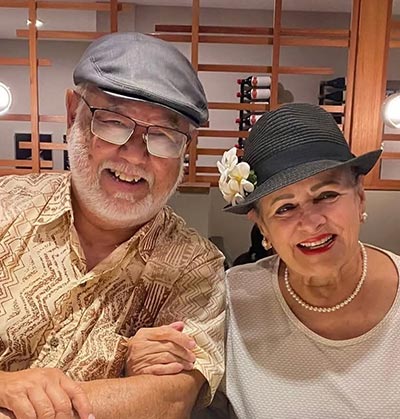
Dwight and Pua Tokumoto. pc-Pua Tokumoto
Dwight is a renowned Hawaiian steel guitarist, composer, and educator based on Hawai‘i Island. He is a graduate of the University of Hawai‘i with a Bachelor of Music degree, and has a long musical career performing live and collaborating with many artists.
He has played the steel guitar on several notable albums including "Lei Maile" by Mark Yamanaka; "Hula Ku‘i" by Kahulanui; "Slack-Key Christmas" by Charles Brotman; and "Sax and Steel - Hula Blues" with saxophonist Bill Noble.
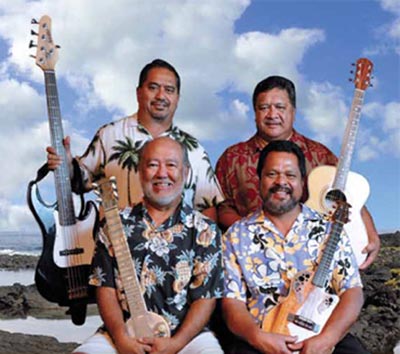
Dwight and Kanakapila. pc-Ke Ola Magazine
Other artists include Diana Aki, Tahitian singer Hina Pankowski, Darlene Ahuna, and Kanakapila.
Dwight played Hawaiian music for many years in Waikīkī at the Princess Ka‘iulani Hotel and the Halekūlani Hotel. He also played in French Polynesia at the Tahiti Beachcomber Hotel and on the Island of Mo‘oera. He has played the steel guitar in Japan for Hawaiian shows and for Japanese Television.
He is also a regular performer at the Hawai‘i Island's Steel Guitar Festivals in Kona, Hilo, and at the Mauna Lani Hotel.
He has played the steel guitar on several notable albums including "Lei Maile" by Mark Yamanaka; "Hula Ku‘i" by Kahulanui; "Slack-Key Christmas" by Charles Brotman; and "Sax and Steel - Hula Blues" with saxophonist Bill Noble.
Dwight is a retired Special Education teacher and has taught in the public school system in California and Hawai‘i. He also teamed up with Slack key guitarist Cyril Pahinui to teach Hawaiian music, slack key, and steel guitar to young students at the Connections Charter School in Hilo.
Today Dwight and his wife Pua, are busy running a coffee farm at Laupāhoehoe called Waipunalei. He is a farmer and a steel guitarist with a busy life!
I sat down with Dwight at the Hawai‘i Island Steel Guitar Festival and we had a nice "talk story" about his life as a steel guitarist. We followed that up with a long telephone interview on March 13, 2026. I was at home in Waiehu, Maui and Dwight at his parent's home at Kalihi Valley, O‘ahu. It was the weekend of the big Kona Low rains that came through the islands, and it was pouring heavily outside!
GV: To give our readers a taste of who you are, I'm going to start off by asking you about some of your likes or dislikes.
DT: I'm ready!
Spam and eggs or Loco Moco? Spam and eggs.
Mango or Lychee? Lychee
Sunday Manoa or Hui ‘Ohana? Hui ‘Ohana.
Plumeria lei or kukui nut lei? Plumeria lei.
Mauka or Makai? Mauka.
GV: Where do you live now and where are you originally from?
DT: I now live in Hilo, Hawai‘i but originally, I am from Kalihi Valley, O‘ahu. I went to Kalihi Elementary School, Dole Intermediate School, and I graduated in 1968 from Farrington High School.
My dad was a heavy equipment mechanic and my mother was a housewife who took care of my brother and I. My mom died young, at age 44 so my father and extended family took care of us. My mom was a lover of music who encouraged me to play music.
GV: Did you play music growing up?
DT: I was in the seventh grade I joined the school band at Dole Intermediate. I played the trumpet in the school band all the way until I graduated from high school.
My father was a big fan of Hawaiian music and after pau hana his friends would come to the house to talk story, drink beers and listen to the radio. The Hawaiian music being played always had the steel guitar. We also used to watch Hawaiian music on television where I heard that sound.
One day when I was in the eighth grade my father asked me if I wanted to learn to play the steel guitar from his friend. He told his friend that I was a ‘ukulele player and the friend offered to teach me the steel guitar. I told my father that I was not interested in the steel guitar, I would rather play rock and roll. It turned out that his friend was Benny Rogers, a truck driver and steel guitarist for Genoa Keawe's band!
After graduation from high school I was drawn to the acoustic guitar. I was in Sears one evening in the record department and I heard a recording of Jose Feliciano playing ""Light my Fire" on his acoustic classical guitar. I went "Wow," I fell in love with the sound of his guitar, and that sparked my interest.
I attended the UH soon after I graduated and I met Eddie Suzui in one of my classes. I found out that he was a guitar player and we started to talk about guitar. He was from the Ventures school of guitar playing and had participated in the Battle of the Bands, etc. I didn't have a decent guitar so he helped me pick one out at Harry's Music in Kaimuki.
I got a job working at Star Supermarket in Kalihi where I met Kapono Beamer. He worked with me and we became friends, and started to hang out together after we pau hana. I found out that he played slack key guitar and that his brother Keola was a classical guitarist. Kapono taught me how to play "Light my Fire" on the classical guitar, and I was in heaven. That was the thing for me right there! Until today, I still remember how to play the intro to that song taught to me by Kapono Beamer.
GV: What did you do after graduating from high school?
DT: I went to the University of Hawai‘i (UH) and took some classes for two years, and in 1970 I joined the US Navy. At the time I didn't want to get drafted into the US Army and be sent to Vietnam. So, I joined the Navy before they could draft me into the Army.
Also, my father and uncle were both drafted into the Army and they advised me to join the Navy. The Navy would teach and train me in different skills and vocation. The aptitude tests I took said that I was inclined towards electronics and aviation.
So I went to boot camp in San Diego, California, and Technical School in Memphis, Tennessee, where I studied Aviation and Electronics. After that I went back to San Diego where I was stationed for four years. I was successfully discharged from the Navy in 1974 and then I moved back to Honolulu.
GV: Is this when you went back again to the UH to study Music?
DT: Yes, when I was in the Navy, I caught the bug for playing guitar. So, when I got out, I already made up my mind to go back to the UH because I had so much questions in my mind about music in general. Not necessarily about guitar, but about music in general.
My classmates at the University were piano or wind instrument players training to become concert performers or music educators. Because I wanted to learn the most I could, I majored in music composition. I learned all the theory and all the instruments and the different types of ethnic music. So, I ended up learning about Okinawan, Filipino, Korean, Indonesian, and other musical traditions.
I learned how to use a tuning fork to practice hearing for relative pitch. I carried around a tuning fork and listened to the sound of the "440 A," listening and honing in my hearing to that sound. You memorize the sound and sing the tone. This also helped me hear the intervals between notes.
I had to play an instrument so I chose the classical guitar and my teacher was George Gilmore. Since I wasn't a performance major I learned the traditional classical guitar repertoire. I graduated from the UH in 1980 with a degree in Music Composition.
GV: After you graduated from the UH, what did you do?
DT: In 1984 my wife and I moved back to the mainland, to San Jose, California. I lived there for 15 years teaching in the public schools. I was a special education teacher and I used music therapy to help my students. I also played solo music and with different bands in the area. In the mainland, there was a very active Hawaiian music scene. I played with the Kapalakiko Hawaiian Band and Island Blend.
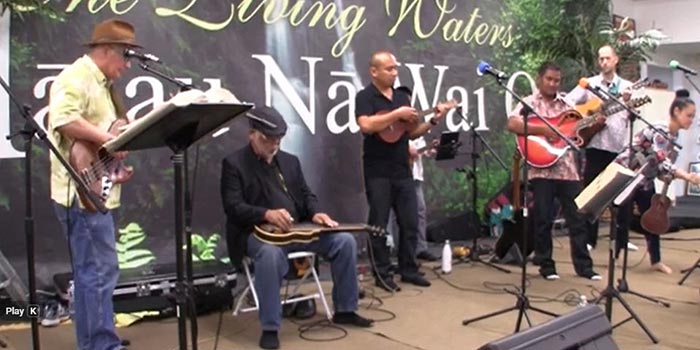
Dwight playing with the Kapalakiko Hawaiian Band
I picked up all kinds of steel guitar books, most of them very old, from the twenties or thirties. I even had one from Alvino Ray! The books didn't seem to fit Hawaiian music, so I finally got one written by Jerry Byrd. It was a great book because he had a logical approach to the tunings and technique. I also listened to recordings by so many artists, if they had a steel I would listen.
1n 1999 I moved back to Hawai‘i. Honolulu was too crowded for my wife and I so we bought land and made a home in Hilo. We've been on Hawai‘i Island ever since then.
FeatureArchives
October, 2026
September, 2026
August, 2026
July, 2026
June, 2026
May, 2026
Complete Issue Archive
Complete Series Archive
Categories
Education and TrainingEntertainment
Equipment
Festivals and Conventions
Instruments and Luthiers
News
Steel Guitar History
Authors
Author IndexHIMELE Events
2026 Festivals and Workshops
Maui Steel Guitar FestivalOctober 17, 2026 - 3:00 PM - 6:30 PM HST
The Shops At Wailea, Wailea, Hawai‘i
Hawai‘i Island Steel Guitar Experience at Mauna Lani
November 19-22, 2026 – Mauna Lani, Auberge Resorts Collection, Waimea, Hawai‘i Island
Other Events
2026 Events
Steel Guitar FridaysEvery Friday – 5:30 PM - 6:30 PM
Royal Grove Stage, Royal Hawaiian Center, Waikīkī
2026 HSGA Festival #
October 22-25, 2026.
Hotel Paradox, Santa Cruz, California
* Tentative
# Registration Fee Required
Copyright ©2026 by Hawaii Institute for Music Enrichment and Learning Experiences, Inc., and Cyberventures Unlimited.Terms of Use
About HIMELE
HIMELE is a Hawai‘i 501(c)(3) non-profit corporation that supports music enrichment and education for people of all ages. Our purpose is to educate, promote, and perpetuate Hawaiian music, Hawaiian culture and Hawaiian musical instruments.
Visit HIMELE
Board of Directors
Mission Statement
Support Us
Learning Resources
Ke Kula Mele Hawai‘i
Hawaiian Steel Guitar Symposium
Statewide Festivals
Kaua‘i Steel Guitar Festival
Maui Steel Guitar Festival
Hawai‘i Island Steel Guitar Festival
Kona Steel Guitar Festival
Hilo Steel Guitar Festival
J-FESTA | Japan-Hawaiian Steel Guitar Festival
Waikīkī Steel Guitar Week
Community Festivals
Ka Makana Ali‘i – Kapolei
Windward Mall – Kāne‘ohe
NextGEN Hawaiian Steel Guitar Festivals
Livestream Hawaiian Steel Guitar Showcase