
Talking Story with Bobby Ingano - Part 1
March 6, 2026 • Geronimo "Geri" Valdriz • Steel Guitar History
Ed. Note: This is the first installment of a new series called "Talking Story with Geri Valdriz". This series will include interviews Geri conducts with Hawaiian steel guitar players. Due to the length of content in these interviews, Talking Story is chapterized, with subsequent chapters slated for future publication. Many of these chapters may contain information about your favorite Hawaiian steel guitar players not previously known to you.
The masthead was created using Google's Nano Banana AI image generator with an actual photo of Geri as a basis. Additional graphics provided by SVGBackgrounds.com
PART ONE
I first met Bobby Ingano in the early 1980s at a Sons of Hawaii concert. We were both there to watch David "Feet" Rogers play the steel guitar. We became friendly, and I later struck a deal with him to trade my '68 Fender Telecaster guitar for a post-war Rickenbacher Frypan lap steel. Since then we have taken different paths in life but we both still have an enduring love for Kīkā Kila, the Hawaiian Steel Guitar.
Today Bobby Ingano is recognized as a legendary master of the Hawaiian Steel Guitar. He is known for his melodic, soulful and "sweet" playing style, and is celebrated as a "local treasure" in the Hawaiian music scene.
He is a highly sought-after studio and touring musician and has worked with diverse artists such as Taj Mahal, Jake Shimabukuro, Los Lobos, Rob Ickes, Wayne Henderson, the Brothers Cazimero, Martin Pahinui, Amy Hanaiali‘i Gilliom, George Kahumoku, Willie K. the Ho‘opi‘i Brothers, and many, many others.
Bobby is also the protégé of steel guitarist David "Feet" Rogers, who instilled "life lessons" into a young developing player..
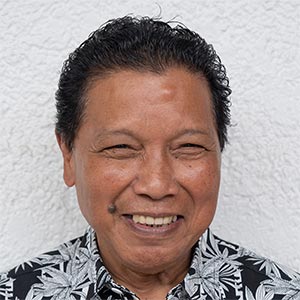
Bobby Ingano. pc-Don Rostow
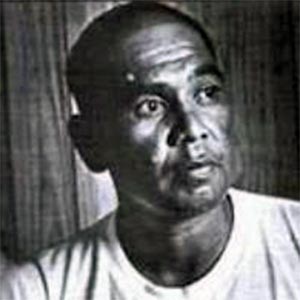
David "Feet" Rogers. pc-Andy Volk
I sat down with Bobby Ingano at the 2025 Hawai‘i Island Steel Guitar Festival and we had a long "talk story" about his life as a steel guitarist. We followed that up with another long telephone interview on January 26, 2026. I was at home in Waiehu, Maui and Bobby was in his patio at "Aiea, O"ahu.
GV: To give our readers a taste of who you are, I'm going to start off by asking you about some of your likes or dislikes.
BI: Okay, shoots.
Spam and eggs or Loco Moco? Spam and eggs.
Mango or Lychee? Mango.
Sunday Manoa or Hui Ohana? This is a hard one, but Hui Ohana.
Flower lei or kukui nut lei? Kukui nut lei.
Mauka or Makai? Another hard one, but Mauka!
GV: Where do you live now and where are you originally from?
BI: Today I live at ‘Aiea Heights, O‘ahu. Originally I am from Lana‘i City, Lana‘i. I spent my first seven years on Lana‘i. My family moved to O‘ahu in 1959. There were two reasons that we moved. The first is that my father got a job promotion working in the office of Dole Pineapple. However, he had to move to Honolulu for that job.
Secondly, I was born in 1952 with the polio virus and at that time there was no vaccine. As a youngster I couldn't keep my balance and walk properly, so I would fall. As time went by my right leg got swollen and became crooked. I was diagnosed by doctors as having Polio and the cure for it came out in 1955.
Back then people were terrified of polio because it could kill you. At school I was separated from playing with other children. However, there was another girl on Lana‘i who had polio and we used to play together in our own sandbox. At the time I thought it was normal and we were just two children having fun!
When I was in the first grade, the doctors told my mother about Shriners Hospital on O‘ahu. I would have to go to Shriners for an operation, physical therapy, and recovery. So the family packed up and moved from Lana‘i to O‘ahu. From 1959 to 1966 I was in and out of Shriners Hospital for operations. In 1959 my family moved to Kam IV Housing in Kalihi and in 1966 we moved to Palama.
GV: What high school did you go to?
BI: I went to Farrington High School and graduated in 1970.
GV: What got you into playing Hawaiian steel guitar in the first place? How did it all start for you?
BI: When I was young I started on ‘ukulele and as a teen I played electric guitar in rock and blues bands. It was 1977 and I was living in Makiki. I was cruising with my brother Stanley in his yellow Volkswagen bug and he put a cassette tape on to listen to music. It was the Gabby Pahinui Hawaiian Band with Gabby playing steel guitar on "Blue Hawaiian Moonlight." That was it.
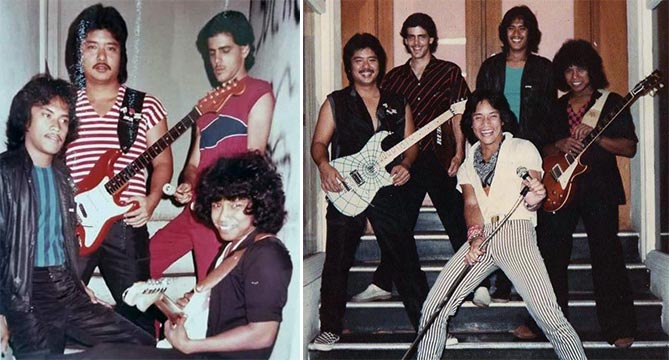
Bobby Ingano in Rock Bands. pc-Bobby Ingano and Gerald K. Gonsalves
When I heard that I never know what was happening to me, all I knew was that I was putting down my electric guitar and I was going to chase down that sound. It was like cupid shooting an arrow right into my heart and that song put me on the path. At the time I didn't know much about Hawaiian music or who Gabby Pahinui was.
Later on my rock/blues band broke up and so I started to play contemporary Hawaiian music. I played Olomana and Kalapana songs and I didn't know the old Hawaiian music yet. One day I played at a gig at the Chinese Cultural Plaza and the Makaha Sons of Ni‘ihau followed my group. After the gig we packed up and left and as we left the parking lot I heard on the car radio "He Punahele No ‘Oe" by the Sons of Hawaii, with Moe Keale on vocals and Feet Rogers on the steel guitar.
When I heard that simple and pure tone of Feet's steel guitar it affected me "real plenty." That's why when I play, I cannot play fast or complicated. I always play simple because to me the simple is the feel. So I went straight to Holiday Mart to buy that Sons of Hawaii record but they were sold out! At the time the Sons were the top Hawaiian music band in Hawai‘i.
Instead, my friend Mike Victorino suggested that I buy the Genoa Keawe "Party Hulas" record with Feet's uncle Benny Rogers on the steel guitar. So I bought it, came home, played the record, and the first song was "Hula O Makee." As soon as I heard Benny Rogers play steel guitar I told myself, "The hell with electric guitar, I gotta play the steel." When I heard his bell harmonics I swear the sound was coming from akua.
So I bought my first lap steel guitar, a Gibson BR 9 student model. At the time I didn't know about steel guitar tunings so for the first year I played it tuned to standard tuning like a regular guitar. I also didn't know about using a bar and fingerpicks. So I played with a socket wrench and a flatpick held in my right hand! I didn't know any steel guitar players, there was no one around to ask, and so I had to learn everything on my own.
My first song that I figured out to play was "Aloha ‘Oe" and I had to use a lot of slants to get the right notes on standard tuning! The first gig that I played the steel guitar was at the Veterans Hall located at the Ala Wai Canal. I played regular electric guitar all night long until the end when I switched to steel guitar and played "Aloha ‘Oe." Sitting right in front of me about 15 feet away were two old timers watching and listening to me play the steel guitar.
After the gig they approached me and the Hawaiian guy shook my hand. I thought that he liked my playing, but he leaned over and said "you get guts playing the steel guitar with a socket wrench and a guitar pick!" Later on I bought a Fender Champ lap steel and kept on experimenting as I continued playing contemporary Hawaiian, Rock, and Blues music.
One of my bandmates is Larry Dupio. His father Jack Dupio approached me about my playing the steel guitar. He was a long time musician that played ‘ukulele in bands around town. He said "You futhead, this is not how you tune one steel guitar." Jack retuned my steel to C6 tuning (C/ E/ G / A /C/ E low to high), and told me to get a steel bar and fingerpicks. At the time I hated fingerpicks and I thought that only Bluegrass musicians used them. So I went down to Harry's Music in Kaimuki and bought my first bar and fingerpicks. When I came home I put the fingerpicks on backwards and they kept flying off my hand!
So now with the C6 tuning on my steel guitar I started to learn and figure out songs from Jerry Byrd and I adapted to the playing styles of Benny and Feet Rogers. All of this I learned by listening closely to their records and I am entirely self-taught. I don't know how to read music and I did poorly in music classes at school.
I also listened a lot to radio station KCCN Hawaiian music. Back then they played a lot of the older swing Hawaiian music and I could hear a flatted 7th note in the steel guitar tunings. Barney Isaacs had a flat seven in his tuning. I was playing the straight C6 tuning at the time and I accidently discovered the flatted 7th note while I was changing my strings. So I changed the low C in my tuning and replaced it with the Bb note. And that gave me a new tuning and I started playing all of the old Hawaiian songs with it. It's a C6 tuning with a low Bb (Bb / E / G / A / C / E low to high).
FeatureArchives
October, 2026
September, 2026
August, 2026
July, 2026
June, 2026
May, 2026
Complete Issue Archive
Complete Series Archive
Categories
Education and TrainingEntertainment
Equipment
Festivals and Conventions
Instruments and Luthiers
News
Steel Guitar History
Authors
Author IndexHIMELE Events
2026 Festivals and Workshops
Maui Steel Guitar FestivalOctober 17, 2026 - 3:00 PM - 6:30 PM HST
The Shops At Wailea, Wailea, Hawai‘i
Hawai‘i Island Steel Guitar Experience at Mauna Lani
November 19-22, 2026 – Mauna Lani, Auberge Resorts Collection, Waimea, Hawai‘i Island
Other Events
2026 Events
Steel Guitar FridaysEvery Friday – 5:30 PM - 6:30 PM
Royal Grove Stage, Royal Hawaiian Center, Waikīkī
2026 HSGA Festival #
October 22-25, 2026.
Hotel Paradox, Santa Cruz, California
* Tentative
# Registration Fee Required
Copyright ©2026 by Hawaii Institute for Music Enrichment and Learning Experiences, Inc., and Cyberventures Unlimited.Terms of Use
About HIMELE
HIMELE is a Hawai‘i 501(c)(3) non-profit corporation that supports music enrichment and education for people of all ages. Our purpose is to educate, promote, and perpetuate Hawaiian music, Hawaiian culture and Hawaiian musical instruments.
Visit HIMELE
Board of Directors
Mission Statement
Support Us
Learning Resources
Ke Kula Mele Hawai‘i
Hawaiian Steel Guitar Symposium
Statewide Festivals
Kaua‘i Steel Guitar Festival
Maui Steel Guitar Festival
Hawai‘i Island Steel Guitar Festival
Kona Steel Guitar Festival
Hilo Steel Guitar Festival
J-FESTA | Japan-Hawaiian Steel Guitar Festival
Waikīkī Steel Guitar Week
Community Festivals
Ka Makana Ali‘i – Kapolei
Windward Mall – Kāne‘ohe
NextGEN Hawaiian Steel Guitar Festivals
Livestream Hawaiian Steel Guitar Showcase